
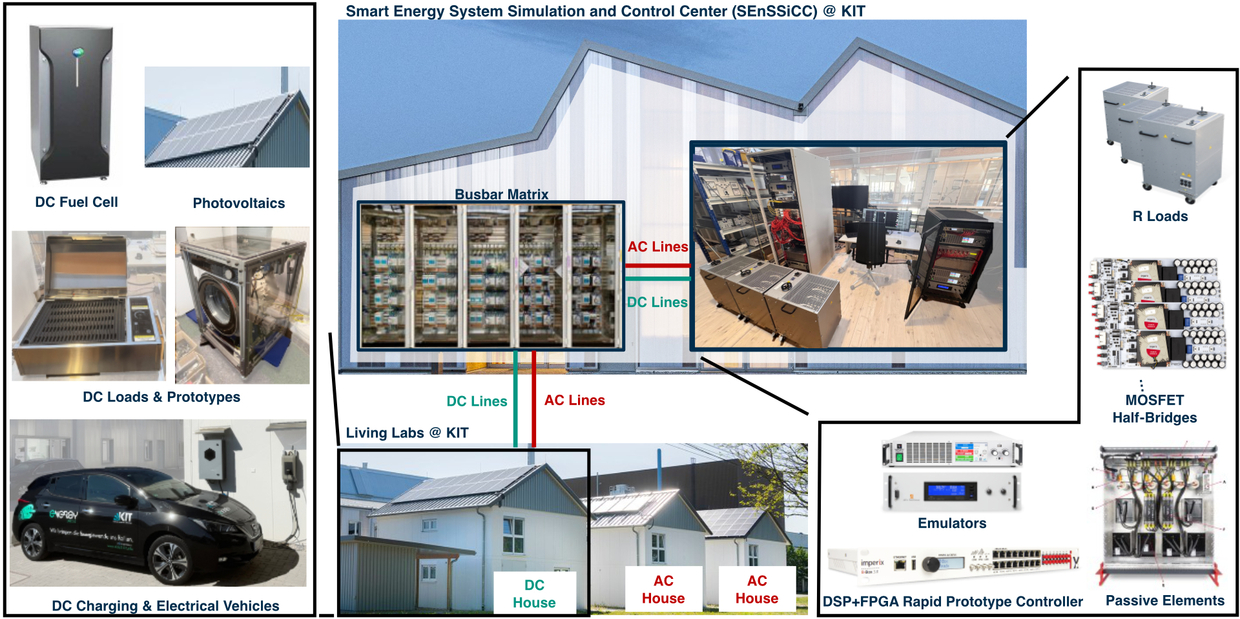
The Smart2DC Microgrid Laboratory is dedicated to the research, development, and experimental validation of innovative technologies for future DC grids.
The successful implementation of the energy transition increasingly requires sustainable, efficient, and decentralized power supply concepts. In this context, direct current (DC) microgrids offer significant advantages: they reduce the number of required AC/DC conversion stages and the associated conversion losses, facilitate the seamless integration of renewable energy sources, and closely match the native electrical characteristics of many modern loads.
The Smart2DC Microgrid Laboratory at the Karlsruhe Institute of Technology (KIT) bridges theoretical research and practical application to address the remaining technical challenges in power electronics and system architectures. As part of the Smart Energy System Simulation and Control Center (SEnSSiCC), the laboratory provides a state‑of‑the‑art open‑science platform on which innovative DC grid concepts can be investigated, tested, and validated under realistic operating conditions.
Objectives and Research Focus
The Smart2DC Microgrid Laboratory is dedicated to the research, development, and experimental validation of innovative technologies for future DC grids. Its primary objective is to establish technical foundations and application‑oriented solutions for the safe, efficient, and scalable operation of DC microgrids.
Research activities focus in particular on key challenges in control, protection, and system integration. These include novel control strategies for stable and decentralized DC microgrid operation, robust integration of renewable energy sources and energy storage systems, and coordinated energy management among multiple grid components. A further emphasis lies on the development of suitable protection concepts, as DC grids impose specific requirements on fault detection, selectivity, and disconnection mechanisms.
In addition, the laboratory investigates power electronic components, system architectures, and the coupling of DC and AC subsystems. Through experimental research under near‑real‑world conditions, the Smart2DC Microgrid Laboratory contributes to evaluating new grid concepts not only from a theoretical perspective, but also in terms of technical feasibility, reliability, and practical applicability.
Infrastructure
The laboratory features a fully modular and highly flexible architecture directly connected to the automated busbar matrix of the Smart Energy Systems Control Laboratory (SESCL). Designed for voltages up to 750 V and currents up to 220 A per connection, the matrix enables the simultaneous integration of up to twelve DC grid nodes, such as sources, loads, or energy storage systems. This setup allows a wide range of grid structures to be realized and enables dynamic reconfiguration of network topologies even during operation.
At the technological core is a high‑performance power electronics platform based on silicon carbide (SiC) half‑bridge modules rated at 800 V and 38 A. For Power‑Hardware‑in‑the‑Loop (PHIL) experiments, the infrastructure is complemented by real‑time controllers with 16 analog‑to‑digital converter channels and programmable, bidirectional 15‑kW laboratory power supplies with auto‑ranging capability up to 1500 V. High‑precision measurement equipment, including galvanically isolated fluxgate current sensors, enables continuous monitoring of all relevant electrical quantities. Together with multi‑level protection schemes, this ensures a high level of operational safety.
In addition, real‑world test environments – most notably the DC experimental building of the Living Lab Energy Campus with a voltage range from 0 to 700 V DC – are seamlessly integrated into the laboratory infrastructure.